
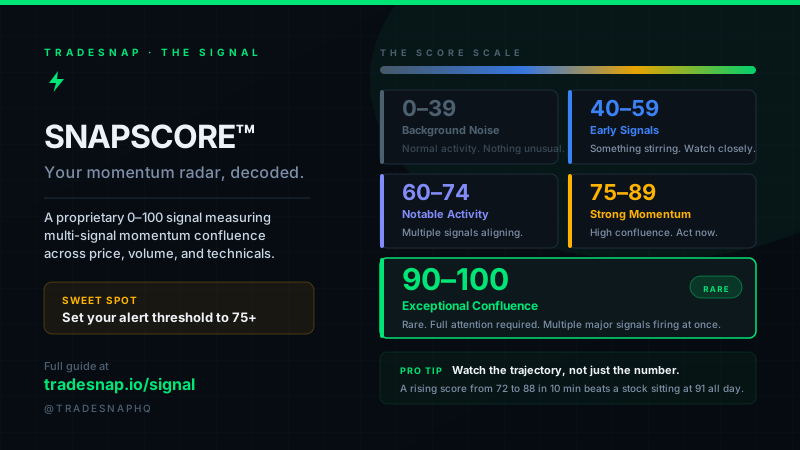
What is SnapScore™?
SnapScore™ is TradeSnap's proprietary momentum signal — a number between 0 and 100 that tells you how much unusual intraday activity is happening on a stock right now, across multiple independent signals simultaneously.
If you've spent any time in the app, you've seen the lightning bolt badge. It's on your watchlist, your alerts, the Live feed, and the Ticker Detail page. It updates every minute during market hours. This guide explains exactly how to read it, how to set your alert threshold, and — just as importantly — how not to use it.
SnapScore™ tells you when a stock is doing something unusual right now — use it to find momentum early, not to make the trade for you.
What it measures — and what it doesn't
SnapScore™ is a short-term momentum signal. Think of it as a confluence meter. On any given day, dozens of signals might be mildly elevated on thousands of stocks. SnapScore™ asks: how many meaningful signals are firing on this ticker at the same time? The more signals in alignment — and the stronger those signals are — the higher the score.
A high SnapScore™ doesn't mean a stock is a good long-term investment. It doesn't mean the stock will definitely go up. It means unusual momentum is building and multiple signals are confirming it simultaneously. That's a very specific, very useful thing to know as a day trader.
SnapScore™ is NOT:
- A buy or sell recommendation
- A fundamental or valuation rating
- A prediction of where the stock will close
- A guarantee of continued movement
The score scale
SnapScore™ runs from 0 to 100. Here's how to think about each range:
0–39: Background noise
Nothing unusual. The stock is trading within normal parameters. Most stocks score here most of the time. Don't chase this range.
40–59: Early signals
Something is starting to stir. One or two signals are elevated, but confluence is limited. Worth a quick look if the ticker is already on your radar — but not worth chasing on its own.
60–74: Notable activity
Multiple signals aligning. This is the range where stocks start showing up meaningfully in scanners. Volume and price action are both moving, and technical positioning is beginning to confirm. Day traders watching for setups should be paying attention.
75–89: Strong momentum
This is where things get serious. A score in the 75–89 range means several high-weight signals are firing simultaneously. These alerts have produced some of the cleanest setups on the platform. The stock is likely moving meaningfully, with volume confirming the move.
90–100: Exceptional confluence
Rare. When a stock hits 90+, it means momentum across nearly every dimension is elevated at the same time. These scores are often associated with stocks experiencing a historic intraday move — parabolic price action, extreme volume, and full technical confirmation all at once. On an average trading day, only a handful of tickers will touch 90+. When one does, it's worth your full attention.
VERU hit SnapScore™ 100 in June 2026, up 167% on 323x its average daily volume. INDP scored 95 the same day, up 95% on 60x average volume. Both triggered consecutive bracket alerts as momentum built — giving subscribers multiple entry windows.
Where SnapScore™ lives in the app
- Live Feed — every SnapScore™ alert shows the score and a summary of which signals drove it. Click into the alert for a full breakdown.
- Watchlist — your saved tickers show live SnapScores so you can monitor momentum building on stocks you're already watching.
- Ticker Detail — click into any ticker for the full SnapScore™ badge with a breakdown tooltip. Updates every minute during market hours.
- Stocks to Watch — morning picks are ranked by SnapScore™. The highest-scoring pre-market movers appear first.
- Alert Detail — when you click into any SnapScore™ alert, you'll see which specific signals contributed to the score.
Setting your alert threshold
This is where most traders get it wrong — either setting the bar too high and missing moves, or too low and drowning in noise. Here's a practical framework:
90+ — Maximum signal quality
Best for traders who want the highest conviction alerts and don't mind fewer of them. You'll get the top tier — stocks experiencing exceptional multi-signal confluence. The tradeoff: by the time a stock hits 90, it may have already made a significant portion of its initial move.
Volume: 1–5 alerts on an active day. Sometimes zero.
75+ — The sweet spot for most traders
Best for active intraday traders who want early awareness without noise. The 75–89 bracket catches strong momentum early, often before the most aggressive part of a move. This is where experienced TradeSnap users typically land.
Volume: 5–15 alerts on an active day.
60+ — Maximum coverage
Best for scalpers, traders who scan constantly, or anyone who wants to watch momentum building from the early stages. Expect more false starts — stocks in the 60s often pull back before continuing — but you'll rarely miss a big move.
Volume: 15–30+ alerts on an active day.
Start at 75. Spend a few weeks watching how stocks behave when they hit 75, 80, 85, 90. Build intuition for the score. Then adjust up or down based on how many alerts feel right for your trading style.
Score trajectory matters more than the number
Here's something that isn't obvious from a single alert: a rising SnapScore™ is often more actionable than a static high score.
A stock sitting at 91 for an hour is different from a stock that was at 72 fifteen minutes ago and just hit 88. The trajectory — the rate of change — tells you something about the momentum behind the move.
When you see consecutive SnapScore™ alerts on the same ticker, pay attention. That means the score has crossed multiple bracket thresholds (60→75→90). Each new alert means the score is still climbing. That's the pattern that produces the biggest intraday moves.
In your alert history, check the timestamps on SnapScore™ alerts per ticker. If they're coming in rapid succession, that's a stock accelerating — not just moving.
Time of day context
SnapScore™ means different things at different parts of the trading day.
9:30–10:30 AM ET — Opening hour
Volume is high across the board, so scores tend to run elevated. A score of 80 in the opening 30 minutes is more common than 80 at 2 PM. Weight the signals more carefully — confirm that the volume is genuinely unusual for this specific stock, not just market-open activity in general.
10:30 AM–12:00 PM ET — Mid-morning
The cleanest SnapScore™ signals. Market-wide noise has settled, and stocks still scoring high are genuinely active. A 90+ in this window is particularly meaningful.
12:00–2:30 PM ET — Lunch and low volume
Volume drops for most stocks. High SnapScores™ in this window often indicate catalyst-driven moves — news, halts, or unusual institutional activity. These tend to be more volatile but also more significant when they occur.
2:30–4:00 PM ET — Power hour
Volume picks up again. SnapScore™ alerts in the final hour can signal continuation or end-of-day squeeze plays. Check whether the stock has been elevated all day or is newly spiking — both matter, but for different reasons.
The right way to act on a SnapScore™ alert
SnapScore™ is a signal, not a trade. Here's the workflow experienced TradeSnap users follow:
- Receive the alert — note the score, the headline (which summarizes the key signals), and the time.
- Check the chart — open the ticker. Is price action clean? Is there a clear trend? Are the candles healthy? The Live feed auto-loads the chart.
- Check the context box — the alert detail shows key stats: OHLC, VWAP, volume ratio, float, short interest. A stock up 40% with 20M float on 200x volume is a very different animal from one up 40% with 500M float on 2x volume — even if they share the same SnapScore™.
- Check for halts — if the stock has been halted today, that context matters. Check the Halts Today count in the stats box.
- Decide quickly or pass — if the setup doesn't feel right in 30–60 seconds, move on. Another alert will come.
Common mistakes to avoid
- Chasing every 90+ score — high SnapScores™ are significant, but not every one produces a clean entry. Some stocks gap up violently before the alert fires and are extended. Use the chart to find your entry — don't chase just because the number is high.
- Ignoring trajectory — a stock scoring 80 that nobody noticed is often more valuable than one scoring 95 that everyone already traded. A fast-rising score is the signal. The absolute number is context.
- Setting threshold too high and missing the build — consider dropping from 90 to 75 for a few weeks and see how many setups you would have seen earlier. The 75–89 bracket catches the move while it's still forming.
- Ignoring low scores on STW picks — if a stock appeared on the morning Stocks to Watch scan, its SnapScore™ during the day is especially meaningful. Even a 65 on a STW pick that's holding pre-market gains tells a story.
- Treating the score in isolation — SnapScore™ is most powerful when combined with the rest of TradeSnap: halt history, dark pool prints, news, and your own chart read. A 90 with a dark pool accumulation spike and a halt in the same morning is a completely different situation than a standalone 90.
Ready to put SnapScore™ to work? Configure your alert threshold in Settings → Alerts → SnapScore™. Pro and Elite subscribers receive real-time SnapScore™ alerts. Start with a free account to explore the platform.