
What just changed
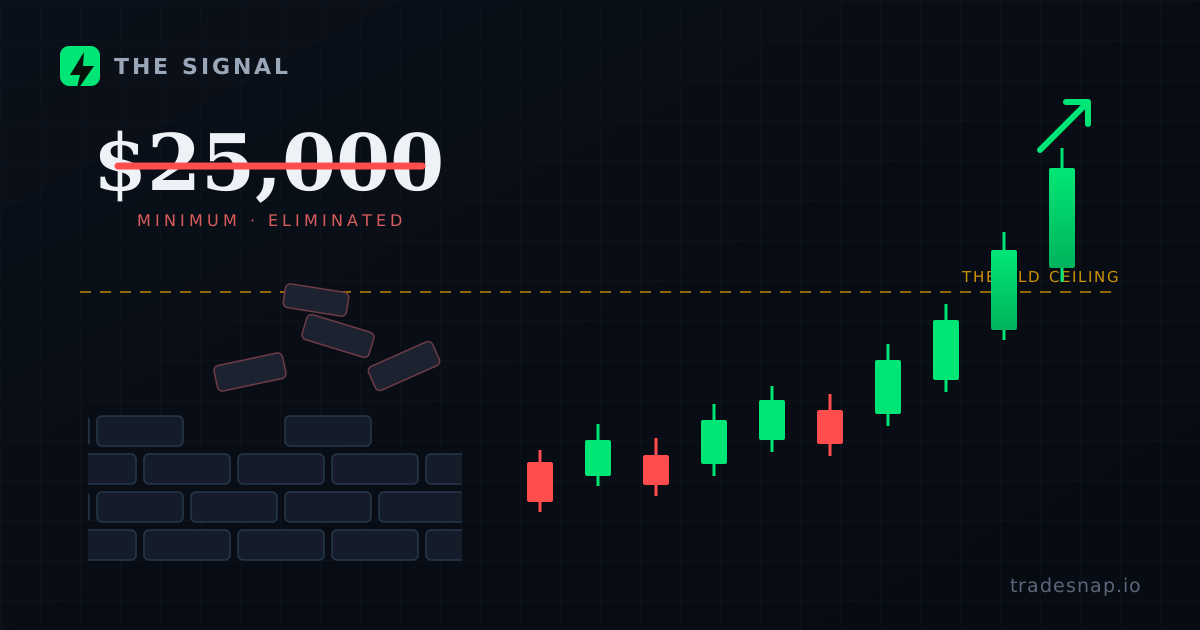
For twenty-five years, one number decided who got to day trade. If your account held less than $25,000, you were rationed to three day trades every five business days. Cross that line and your broker froze you out — no matter how good your setups were or how disciplined your risk was. The number was the wall.
As of June 4, 2026, the wall is gone. The SEC approved FINRA's amendments to Rule 4210 on April 14, 2026, and FINRA confirmed the rollout in Regulatory Notice 26-10. Three things were removed entirely — not reduced, removed:
- The $25,000 floor — you no longer need $25,000 in equity to day trade frequently in a margin account.
- The trade count — the old test that flagged you after four day trades in five business days no longer exists.
- The "pattern day trader" designation — the label, its buying-power formula, and the liquidation-only penalty that followed a violation are all gone.
The standard $2,000 minimum to trade on margin at all still applies, and Regulation T still governs initial margin. The change covers only US equities and equity options at FINRA member brokers — futures, forex, and crypto were never part of the PDT rule. And brokers have until October 20, 2027 to fully implement, so whether it's live depends on your broker.
Why the $25,000 rule existed
The PDT rule wasn't arbitrary cruelty. It was born in 2001, in the wreckage of the dot-com crash, when a wave of newly online retail traders had margined themselves into serious losses. Commissions were high, real-time risk monitoring barely existed, and regulators wanted a capital cushion thick enough to let active traders absorb a bad streak — and to slow down the undercapitalized before they did real damage.
That logic made sense in 2001. It made less sense every year after. Commissions fell to zero. Brokers built real-time risk engines that can re-price buying power on every tick. In its approval, the SEC essentially acknowledged that the old trade-counting mechanism had become disconnected from how risk is actually managed at a modern brokerage. A flat $25,000 line is a blunt instrument. Dynamic margin is a scalpel.
What replaces it
Instead of counting trades, the new framework watches exposure. Your intraday buying power updates throughout the session based on your real-time margin excess. Brokers can choose to monitor accounts continuously — blocking trades that would create a margin deficit — or run a single end-of-day check.
Here's the part the celebration skips: a risk-based system isn't automatically more generous. The old framework handed flagged accounts a flat 4:1 intraday buying power. The new one is sensitive to what you trade. Concentrate your account in one volatile low-float small-cap and a real-time risk engine may extend you less leverage than the old formula did. The system rewards liquidity and diversification and penalizes concentration in exactly the names small accounts love to chase. That's not a bug — it's the design.
A door opens — and a guardrail disappears
For hundreds of thousands of small-account traders who were locked out of legitimate intraday strategies, this is a genuine win. Access shouldn't have depended on a 25-year-old dollar figure. Markets noticed too — retail brokerage stocks rallied on the approval, with Robinhood jumping nearly 8% the day it was announced, on the expectation of more volume from smaller accounts.
But there's a subtler point experienced traders were quick to make. For all its clumsiness, the $25,000 floor functioned as an accidental risk filter. It capped how fast an undercapitalized beginner could do damage — three trades, then a forced cooling-off. With the floor gone, anyone with $2,000 and a margin account can now overtrade themselves into a hole with no external brake at all. There's even a systemic wrinkle: when a sharp sell-off hits and dozens of brokers' real-time risk engines tighten at the same moment, you can get a cascade of forced liquidations that wasn't possible under the old end-of-day model.
The part no rule change can fix
The uncomfortable truth this change doesn't touch: most day traders lose money. The bid-ask spread still eats small accounts proportionally harder. Algorithms still hold a speed and information advantage. Psychology is still the hardest opponent in the room. The rule never had anything to do with any of that.
Removing the $25,000 barrier means more people can try day trading — not that more will succeed. Studies consistently put the failure rate in the 70–90% range, and none of that had anything to do with the PDT rule. The change is good for access. It is neutral-to-dangerous for anyone who mistakes permission for preparation.
Where TradeSnap provides ballast
Ballast doesn't make a boat faster. It keeps it from capsizing when the water gets rough. That's the right way to think about TradeSnap in this new regime. The PDT rule, for better or worse, was an external brake. Now that brake is gone — which means the discipline and the information have to come from you. TradeSnap exists to make that easier in three concrete ways.
Context before conviction
When you can fire unlimited round trips, the temptation is to react to every wiggle on the chart. TradeSnap is built around a single question — why is this moving? Every alert opens the catalyst behind it: a halt, a dark pool print, a filing, a momentum surge. Acting on a reason instead of a candle is the difference between a trade and a flinch — and it matters far more now that nothing is counting your flinches for you.
A read on whether the move is even real
SnapScore™ reads price action, volume, and technicals into one 0–100 momentum score, so you can tell a setup with legs from a dead-cat bounce before you commit risk — at a glance, instead of juggling ten indicators. It's a momentum signal, not a recommendation and not a promise. It's there to help you filter, which is exactly the skill the old rule used to enforce for you.
A mirror that remembers
The old rule capped a small account's mistakes at three per five days. There's no cap now — so reviewing your trades and catching your own patterns is no longer optional. TradeSnap's journal logs what was actually happening in the market when you traded, and the AI Coach surfaces the habits quietly costing you money. The brake the regulation used to provide, you now build yourself, one reviewed trade at a time.
None of this makes you profitable — nothing can promise that, and you should be suspicious of anything that claims otherwise. What context and discipline do is tilt the odds toward the small minority who last, and give you a fighting chance against a market that just opened its doors wider without making itself any kinder.
The $25,000 wall coming down is a fairer world. A door that should have opened years ago finally did. But a door is not an edge, and freedom is not a strategy. The traders who do well over the next few years won't be the ones celebrating that the rules got easier — they'll be the ones who replaced the rule's external brake with internal discipline and better information.
This article is for educational purposes only and is not a recommendation to trade. Day trading carries a substantial risk of loss, and most day traders lose money. SnapScore™ is a short-term momentum signal, not a fundamental rating or a buy/sell recommendation.
Trading with more context, not more noise. TradeSnap surfaces the catalyst behind every move — halts, dark pool prints, momentum, and more — the moment it happens. Start with a free account and see what trading with the why feels like.