
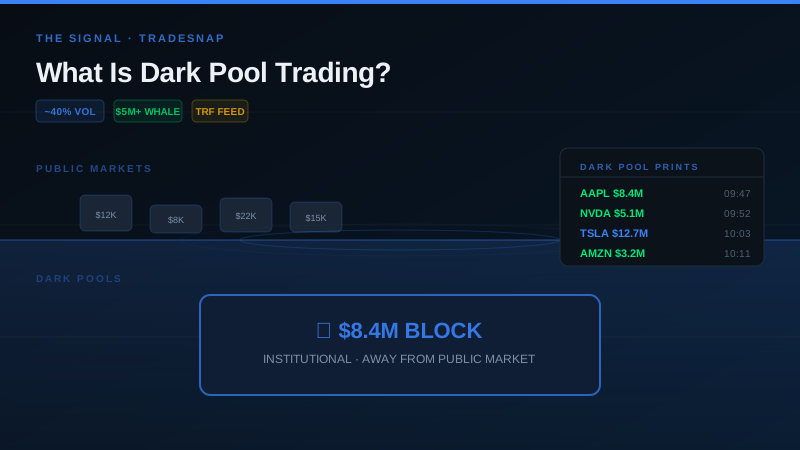
What is a dark pool?
A dark pool is a private exchange — or alternative trading system (ATS) — where institutional investors buy and sell large blocks of stock away from the public market. Unlike NYSE or NASDAQ, dark pools don't display order books publicly. Trades are executed privately and only reported after the fact.
The name sounds ominous, but dark pools exist for a practical reason: when an institution needs to buy or sell millions of shares, doing it on a public exchange would move the market against them. A pension fund liquidating a $50M position on NASDAQ would telegraph their move to every market participant, driving the price down before they finish selling. Dark pools allow them to transact quietly.
Most retail traders have no idea this market exists. Their brokerage shows them the public order book — but nearly half of all US equity volume never appears on that book at all. It's already traded.
How big is the dark pool market?
The scale is staggering. Roughly 40% of all US equity volume — hundreds of billions of dollars per day — trades in dark pools, broker internalization, and other off-exchange venues. This isn't fringe activity; it's how institutions move size.
Major dark pool operators include Goldman Sachs (Sigma X), Morgan Stanley (MS POOL), JPMorgan (JPM-X), and dedicated alternative trading systems like IEX and LIQUIDNET. Every major bank and many independent firms operate their own dark pool.
How dark pool trading works
When an institution wants to buy 500,000 shares of a stock, they submit the order to a dark pool rather than a public exchange. The dark pool matches buyers and sellers internally — often at the midpoint of the public bid-ask spread. If no match is found internally, the order may be routed elsewhere or broken into smaller pieces.
Because the order never touches the public exchange, retail traders watching Level 2 quotes and time and sales see nothing. No large bid. No large ask. No print on the tape — until after execution.
What is the Trade Reporting Facility (TRF)?
This is where it gets interesting for day traders. Dark pool trades don't disappear — they're required by regulation to be reported to a Trade Reporting Facility (TRF) within seconds of execution. FINRA operates the primary TRF, and this reporting is what makes dark pool data accessible (with a short delay) to the public.
When you see a large print appear on a time and sales feed marked as "TRF" — rather than NYSE, NASDAQ, or ARCA — that's a dark pool transaction surfacing. The trade already happened. What you're seeing is the report.
TRF prints typically surface within seconds of execution. Fast access to this data — and the tools to filter signal from noise — is the edge. Most retail platforms don't surface this data at all.
Why day traders watch dark pool prints
Dark pool prints are, in isolation, just data. The question is what they mean. Here's why active traders pay attention:
- Institutional conviction — when a single entity puts $5M+ into one trade, they've done the analysis. They're not trading on a hunch. That conviction has meaning.
- Directional signal — a large buy-side print often precedes price movement. Institutions accumulate before catalysts, not after. Catching a large print before a move is the goal.
- Accumulation patterns — a single whale print is interesting. Multiple prints on the same ticker in a short window — what TradeSnap calls an accumulation spike — is more significant. Someone is building a position.
- Confirmation of momentum — when a stock is already moving on SnapScore™ signals and dark pool prints are stacking up, that's confluence. Multiple independent signals pointing the same direction.
Whale prints vs. accumulation spikes
TradeSnap distinguishes between two types of dark pool signals:
Whale prints
A single block trade above a configurable threshold (default: $5M). One institution. One decision. One large print. These are notable on their own — especially on smaller-cap stocks where a $5M print represents a meaningful percentage of daily volume.
Accumulation spikes
Multiple prints on the same ticker within a 5-minute window that total above a threshold (default: $10M). This pattern suggests an institution is breaking up a larger order — buying in pieces to avoid moving the market. The total is more significant than any single print, and the rate of accumulation matters.
TradeSnap's dark pool alert engine monitors both patterns in real-time, fires alerts when thresholds are crossed, and deduplicates so you don't get spammed — one alert per ticker per 30 minutes regardless of how many prints occur.
How TradeSnap surfaces dark pool data
TradeSnap connects directly to exchange feeds via WebSocket and captures TRF prints in real-time. Every print above $100K is surfaced in the Dark Pool Scanner feed. Every print above $500K is stored in the database for historical analysis.
Elite members get:
- Live Dark Pool Scanner — a real-time feed of prints with size, price, ticker, and venue
- Whale alerts — push notifications when a single print crosses your configured threshold
- Accumulation alerts — notifications when a ticker accumulates a configured dollar amount within a 5-minute window
- SnapScore™ integration — dark pool activity contributes to a ticker's SnapScore, so you see the signal even if you're not watching the scanner directly
Dark pool data is available on the Elite plan. The scanner, alert configuration, and historical prints are all included.
Want to track institutional dark pool activity in real-time? TradeSnap's Dark Pool Scanner is available on the Elite plan. Start with a free account and explore the platform.