
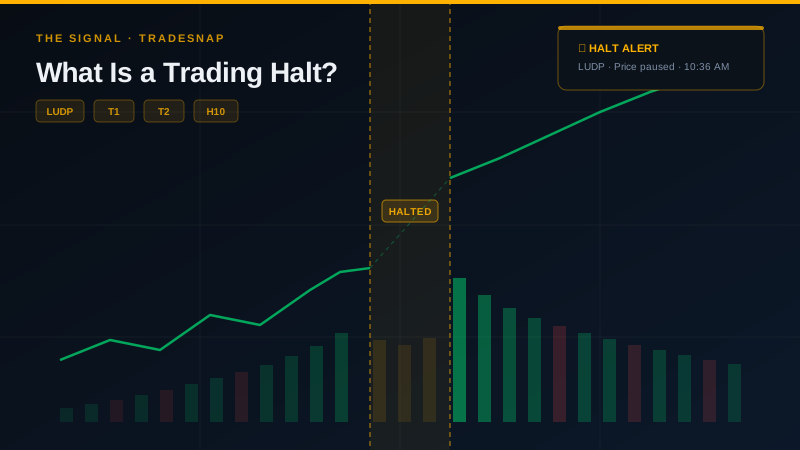
What is a trading halt?
A trading halt is a temporary pause in buying and selling activity for a specific stock. During a halt, no orders can be executed — the ticker freezes. Depending on the reason, a halt can last a few minutes or several hours.
Halts are triggered by exchanges (NYSE, NASDAQ) or, in rare cases, by the SEC. They exist to protect investors from trading on incomplete or misleading information — but for active day traders, they represent something else entirely: a moment of extreme volatility potential.
When a stock resumes trading after a halt, price can gap significantly in either direction. The traders who already knew the halt happened — and why — are positioned. Everyone else is reacting.
The 6 halt codes explained
Every trading halt carries a code that tells you why it happened. Understanding these codes is essential for interpreting what a halt means and what's likely to happen when the stock resumes.
LUDS — Limit Up / Limit Down (Price Move)
The most common halt code. LUDS halts fire automatically when a stock moves too fast in either direction within a short window — typically a 10% move within 5 minutes for stocks priced above $3. The exchange pauses trading for 5 minutes to let the market stabilize.
What it usually means: Significant news, unusual volume, or a momentum squeeze. LUDS halts on the way up are often the most interesting — they can signal a breakout that still has room to run.
LUDP — Limit Up / Limit Down (Pause)
A variation of LUDS, LUDP fires when the stock's National Best Bid and Offer (NBBO) moves outside the price band but the halt is shorter — typically 15 seconds. If the price stabilizes, trading resumes automatically without a full 5-minute pause.
T1 — News Pending
A T1 halt means the company has requested a trading pause while it prepares a material announcement. This could be an earnings release, a merger, an FDA decision, or any news event significant enough to require a prepared statement.
What it usually means: Something is coming. T1 halts can last minutes to hours. When they lift, price typically makes a decisive move in the direction of the news.
T2 — News Released
Similar to T1, but the news has already hit. The exchange halts trading briefly to allow market participants time to read and process the announcement before orders start flying.
T5 — Single Stock Circuit Breaker
A T5 fires when a stock moves 10% or more within 5 minutes during regular market hours. It's essentially the single-stock version of a broader circuit breaker. The halt lasts 5 minutes.
H10 — SEC Trading Suspension
The most serious halt code. An H10 means the SEC has suspended trading — typically due to suspected fraud, material misrepresentation, or inability to verify basic facts about the company. H10 suspensions can last 10 trading days and are a red flag for fundamental issues with the stock.
What it means for traders: Avoid. Unlike other halts, H10s often don't have a clean resumption and carry significant regulatory risk.
Why stocks get halted
Beyond the specific codes, there are a few common patterns that lead to halts:
- Earnings surprises — a company reports numbers wildly above or below expectations
- M&A announcements — acquisition rumors or confirmed deals
- FDA decisions — biotech stocks frequently halt on drug approval news
- Short squeeze dynamics — stocks with heavy short interest can trigger LUDS halts as they squeeze
- Promotional activity — penny stocks sometimes halt due to suspicious promotional campaigns (a red flag)
- Technical errors — occasionally a halt is triggered by a system glitch, not fundamental news
What happens when a halt lifts
When a halt lifts, there's typically a brief auction period — a few minutes where buyers and sellers submit orders before the stock reopens for regular trading. This auction determines the reopening price.
The reopening price is often substantially different from where the stock was trading when it halted. On positive news, it gaps up. On negative news, it gaps down. On LUDS halts with no new information, it often resumes near where it paused.
The first few minutes after resumption are among the highest-volume, highest-volatility moments in day trading. Price can move quickly, liquidity can be thin, and spreads can be wide. Knowing the halt is coming — and why — gives you time to prepare.
How active traders use halt alerts
The edge in halt trading isn't just knowing a stock halted — it's knowing as soon as it halts and understanding the context. Here's how experienced traders approach it:
- Get the alert immediately — every second matters. By the time you see it on a chart, others are already positioned.
- Identify the halt code — T1 means news is coming. LUDS means price is moving fast. These require different setups.
- Check the broader context — what's the float? Has this stock halted before? Is the sector moving? What was the volume before the halt?
- Plan your entry/exit before resumption — decide your price levels during the halt, not after the stock reopens.
- Watch the auction — where does price open relative to where it paused? That opening move sets the tone.
Stocks with halt history often halt again. Once a ticker has proven it moves on halts, it tends to attract the same traders repeatedly. TradeSnap's SnapScore™ gives a bonus to tickers with halt history for exactly this reason.
How TradeSnap detects halts in real-time
TradeSnap monitors NASDAQ's exchange feeds and fires a halt alert within approximately 30 seconds of a halt being posted — identifying the halt code, the price at the time of the halt, and the ticker's broader context including float, volume, and whether it appeared on that morning's Stocks to Watch list.
On the Live Feed, halt alerts appear instantly with the code, ticker, and a summary. Click any halt alert and you'll see the chart, key stats, and recent news for that ticker — everything you need to make a decision before the stock resumes.
Halt alerts are available on all plans, including free. The difference on Pro and Elite is that halt alerts arrive via push notification — so you don't have to be watching the screen when one fires.
Ready to start catching halts in real-time? Start a free 7-day trial — full access to our suite of advanced trading tools.